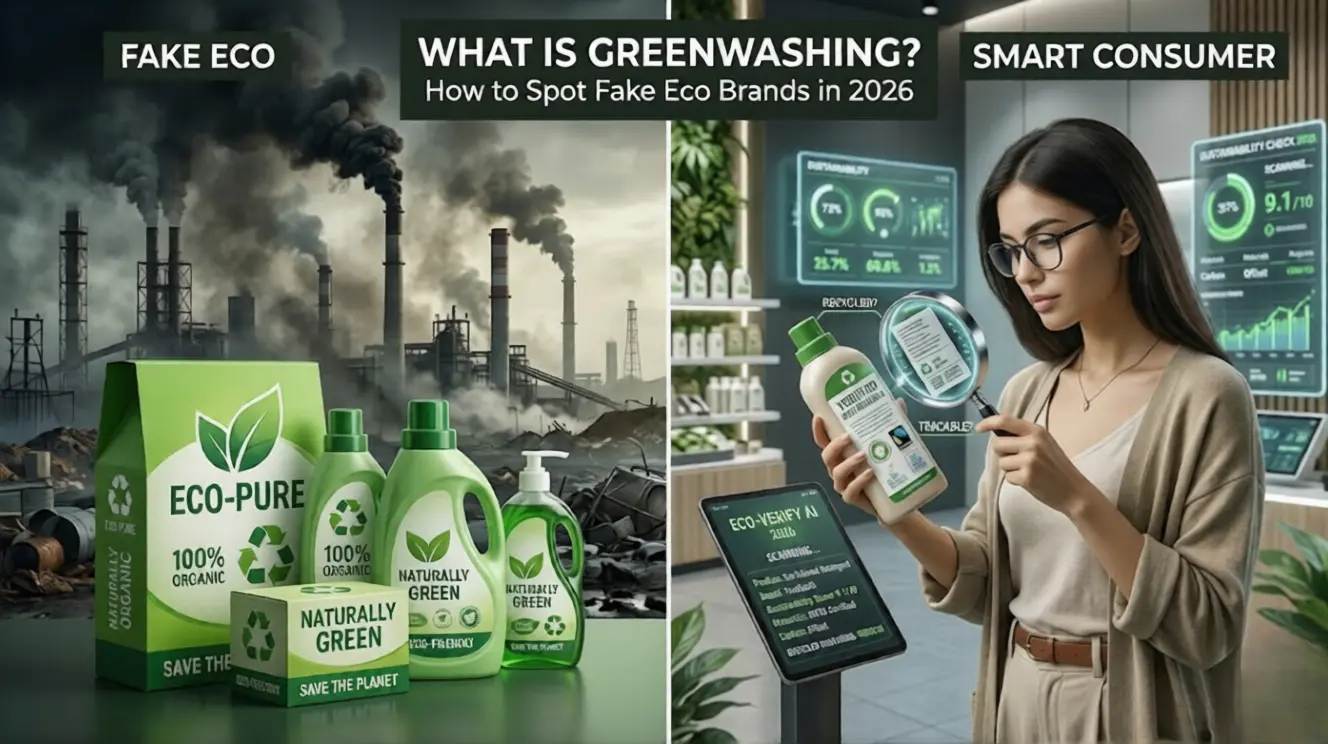
Greenwashing is when a company makes itself appear more environmentally responsible than it actually is using misleading labels, vague slogans, and unverified "eco" claims to attract conscious consumers without making real changes. In 2026, greenwashing examples are everywhere: from fast fashion "conscious collections" to oil giants calling themselves "carbon neutral." This guide breaks down exactly what greenwashing looks like, who got caught, and how you can stop falling for it.
Walk into any supermarket today. You'll see words like "eco-conscious," "planet-friendly," "sustainably sourced," and "carbon-neutral" plastered on everything from shampoo to sneakers. Sounds great, right?
Here's the problem: most of it is a lie.
Greenwashing is the practice of making a brand appear more sustainable than it really is. Sometimes it's deliberate deception. Other times it's sloppy marketing brands slapping a green leaf logo on packaging while their supply chain quietly destroys rainforests. Either way, the result is the same: you think you're making an ethical choice when you're not.
The term was coined by environmentalist Jay Westerveld in 1986, when he noticed hotels telling guests to reuse towels "to save the environment" while simultaneously expanding their resorts along fragile coastlines. Forty years later, the tactic has become a sophisticated, billion-dollar industry.
Quick Definition: Greenwashing = misleading environmental marketing designed to make companies look sustainable without the substance to back it up.
You'd think greenwashing would decline as consumers get smarter. The opposite is happening.
A global survey found that 91% of consumers believe at least some brands engage in greenwashing, indicating widespread distrust in environmental marketing claims. And yet brands keep doing it because it still works on enough people to be profitable.
While overall greenwashing cases dropped 12% in 2025, high-severity cases those causing major legal, financial, or environmental harm rose 30%, and nearly a third involved repeat offenders. These aren't accidents. They're calculated strategies.
The eco-products market is booming. Consumers are genuinely willing to pay more for sustainable goods. That financial incentive means companies invest heavily in looking green rather than being green. As consumers pay more attention to how products are made, companies are using more sophisticated and harder-to-spot greenwashing techniques relying on legally meaningless terms, highlighting trivial "green" features while concealing major harms, and launching "eco collections" that represent less than 1% of production.
And the regulatory landscape? Still catching up.
Let's look at the most notable greenwashing examples 2026 and recent years. These aren't small companies. They're some of the biggest names on the planet.
Fast fashion's most controversial player got a serious wake-up call. Shein was hit with a €1.15 million fine from Italy's competition authority for misleading environmental claims on its European websites. The fine specifically called out how the fast-fashion giant overstated sustainability practices without clear evidence to back them up.
Shein sells thousands of new styles daily at ultra-cheap prices, a business model fundamentally incompatible with sustainability. Yet the brand's marketing leaned heavily into eco-language. Regulators finally said: prove it or stop.
In a landmark case in a Paris court in October, advertising for TotalEnergies was declared illegal for greenwashing. The French oil major has a 2050 net zero target and had been claiming to be a "major player in the energy transition" despite continuing to promote and sell more fossil fuels with plans to drill for oil and gas in Iraq, Denmark, Tanzania and Uganda. The ruling was the first greenwashing judgment ever issued against the oil industry's decarbonisation narrative.
This is huge. If a company's core business model is extracting fossil fuels, calling yourself a "green transition leader" is not a marketing spin, it's illegal.
A 2021 report from the Changing Markets Foundation looked at clothing from major high-street fashion brands and found 60% of claims overall were misleading. H&M were found to be the worst offenders with a shocking 96% of their claims not holding up.
H&M's "Conscious Collection" was marketed as the brand's more sustainable option. In reality, it was a small fraction of their overall production which relies on fast-fashion speed, synthetic fabrics, and disposable consumption. The word "conscious" is legally meaningless and requires no verification.
Toyota, the world's biggest carmaker, was called out by Greenpeace for promoting biofuel-powered prototype vehicles as a decarbonisation solution at COP30. The non-profit said that expanding biofuel production threatens tropical forests, food security, and climate goals and noted that the Japanese carmaker is responsible for 1.5% of global emissions.
An analysis revealed that companies like Shell spent 81% of their advertising on greenwashing claims, promoting sustainability, while still investing 80% of their funds in oil and gas exposing a stark contrast between their public claims and actual practices.
A company can say anything in an ad. But where the money goes tells the real story.
One of history's most expensive greenwashing scandals. Volkswagen admitted to cheating on pollution tests by fitting various vehicles with a "defect" device software that could detect when it was undergoing an emissions test and altering the performance to reduce the emissions level. In actuality, these engines were emitting up to 40 times the allowed limit for nitrogen oxide pollutants.
This has cost VW somewhere in the range of 31 billion euros so far. The financial cost of getting caught is real. The environmental cost was worse.
Tyson Foods agreed to stop marketing certain products as "climate-friendly" and drop its net-zero by 2050 claims after environmental groups accused the company of creating a misleading impression about beef's actual climate impact. Beef is one of the most carbon-intensive foods on the planet. Calling it "climate-friendly" was, to put it plainly, absurd.
Understanding the types makes it far easier to spot in real life. Greenwashing isn't one trick, it's a toolkit.
1. Vague Claims
Words like "natural," "eco-friendly," "green," or "conscious" have no legal definition. Any brand can use them. They mean nothing without specific, verifiable data behind them.
2. Hidden Trade-offs
A product might be made from recycled materials but shipped from the other side of the world in non-recyclable packaging, manufactured in a coal-powered factory. This type of greenwashing is called "selective disclosure" companies promote their Earth-minded practices as a mask for the carbon-heavy skeletons in their closets.
3. Fake or Unverified Certifications
Brands create their own sustainability labels with no third-party verification. A leaf icon or a "100% eco" badge means nothing unless issued by a recognized certifier like B Corp, Fair Trade, FSC, or GOTS.
4. Carbon Offset Abuse
A company is truly carbon neutral only when it measures all its emissions, reduces them as much as possible, and offsets the remainder using high-quality, verified projects. But there's no universal legal standard for using the term "carbon neutral" in the U.S. or most global markets. A brand can buy cheap, unverified carbon credits sometimes for projects that would've happened anyway and still label itself "carbon neutral."
5. Irrelevance
Claiming a product is "CFC-free" when CFCs have been banned for decades. It's technically true and completely meaningless.
6. Greenrinsing (New in 2025)
In 2025, green rinsing emerged as a new form of greenwashing in which companies set ambitious net zero targets to attract investors only to water them down or quietly drop them later. Multinationals including Air New Zealand, Shell, BP, Unilever, Volvo and Coca-Cola weakened or delayed their sustainability targets.
7. Micro-Green Collections
By creating small "eco-friendly" collections, manufacturers can capitalize on the growing consumer demand for sustainable products without making significant, systemic changes to their core business model, even as the company's main business model continues to pollute.
Here's your practical checklist. If a brand does several of these things, walk away.
1: "Natural," "Green," "Eco," "Conscious" With No Proof
These words are unregulated. Any brand can use them. Ask: what specifically makes this eco-friendly, and how was it verified?
2: Generic "Carbon Neutral" Claims Based Only on Offsets
Under the EU's new ECGT rules effective September 2026, product-level claims of carbon neutrality relying on compensation rather than actual emission reductions within the supply chain are explicitly blacklisted. If a brand's "carbon neutral" claim is based entirely on buying cheap offset certificates not actual emission cuts that's a red flag.
3: A Tiny "Eco Collection" in a Sea of Fast Fashion
If a fast fashion brand sells 10,000 new styles a week and launches a 50-piece "sustainable line," that line is a marketing tool, not an environmental commitment.
4: No Third-Party Certification
Genuine sustainability brands have verifiable certifications. Look for: B Corp, GOTS (Global Organic Textile Standard), Fair Trade Certified, FSC (Forest Stewardship Council), OEKO-TEX, Cradle to Cradle. A company-invented badge with no external auditor is meaningless.
5: Vague Net Zero Targets With No Interim Milestones
Grand statements like "We're going carbon neutral by 2050!" can be inspiring. Or they can be classic greenwashing when a company offers no roadmap. A genuine net zero target comes with measurable interim targets like "50% emissions reduction by 2025, verified by XYZ." Over-reliance on carbon offsets instead of actually working to reduce emissions is another warning sign.
6: Green Packaging, Unchanged Product
Switching from a plastic bag to a paper bag while keeping the same unsustainable production process is cosmetic change. McDonald's paper straws that couldn't be recycled is the iconic example of this.
7: No Supply Chain Transparency
Sustainable brands can tell you where their materials come from, who made them, and what environmental standards the factories meet. Vague answers like "we care about our suppliers" are not enough.
8: "Biodegradable" or "Compostable" Labels Without Context
Unless you have access to a specialized industrial composting facility (which most people don't), a "compostable" product could persist in the environment just as long as conventional plastic. "Biodegradable" without specifying conditions and timeframe is meaningless.
9: 100% Renewable Energy Claims Via RECs, Not Direct Power
Some energy suppliers sell "green energy plans" backed by Renewable Energy Certificates essentially paperwork rather than a physical clean energy connection. Switching to a "green" energy plan can support clean power, but only if it's genuinely designed to drive actual change.
10: AI-Polished Sustainability Copy With No Data
In 2026, brands use AI to generate smooth, confident-sounding sustainability content with zero substance behind it. If a brand's entire sustainability page is beautiful prose with no specific numbers, no certifications, and no third-party audits, that's a red flag.
The regulatory environment is genuinely tightening. Here's what changed.
The European Commission has published a detailed guidance document on the Greenwashing Directive's environmental claims rules, which EU Member States will have to enforce from September 27, 2026. The Greenwashing Directive updates the EU's consumer protection rules to tackle greenwashing and promote products that are durable and sustainable.
Under this law, the rules will apply from 27 September 2026. From that date, enforcement action can be taken against businesses making prohibited environmental claims.
Specifically prohibited from September 2026: generic green claims and offset-based product "climate neutral" claims across the EU, forcing a fundamental redesign of how brands talk about environmental performance and carbon credits.
As of June 20–23, 2025, the European Commission announced its intention to withdraw the Green Claims Directive proposal and paused the legislative process. The decision followed feedback that the proposal could create disproportionate requirements for micro-enterprises across the EU. However, other EU laws on sustainability claims are still in progress. The Empowering Consumers Directive will be enforced starting September 2026.
The FTC's Green Guides, the main framework governing environmental marketing claims in America, are over a decade old. Watch for updates from the FTC on green marketing guidelines. While enforcement may be shifting, the guidelines themselves set important standards for what constitutes legitimate versus deceptive environmental claims.
The FTC has previously fined Keurig $1.5 million for falsely claiming their K-Cups were recyclable, and ordered Kohl's to pay $2.5 million and Walmart $3 million for marketing rayon products as "bamboo."
Knowing what not to trust is half the battle. Here's what genuine sustainable brands look like:
They name specific certifications B Corp, Fair Trade, FSC, GOTS, OEKO-TEX issued by credible, independent third parties with public audit processes.
They give you numbers, not adjectives "30% recycled polyester" not just "eco-friendly materials." "Emissions reduced 42% since 2019" not just "committed to the environment."
They acknowledge limitations. A brand that says "we're not perfect yet, here's where we are and where we're going" is more credible than one that calls itself a planet-saving hero.
They publish supply chain information Who made your product, where, and under what conditions. Brands like Patagonia publish detailed factory lists and audit reports.
Their sustainability page has dates, data, and external links Not just marketing copy, but actual reports, third-party audits, and year-on-year progress metrics.
A third of UK consumers express skepticism about green labels and sustainability claims, while 28% struggle to identify genuinely sustainable products due to inconsistent labeling underscoring the need for clearer standards. Until those standards are globally enforced, your critical eye is your best tool.
Q: What is the most famous greenwashing example?
The most cited case is Volkswagen's "Dieselgate" scandal, where the company's diesel vehicles were secretly programmed to cheat emissions tests emitting up to 40 times the legal limit of nitrogen oxides in real-world driving. VW had been actively marketing these cars as low-emission and eco-friendly. The scandal has cost the company over €31 billion.
Q: Is greenwashing illegal?
Yes, increasingly so. In the EU, the Greenwashing Directive (ECGT) comes into force September 27, 2026, banning specific misleading practices including unverified carbon-neutral product claims. In the US, the FTC can take action under its Green Guides. Companies can face multi-million dollar fines, court-ordered ad bans, and mandatory retractions.
Q: What's the difference between greenwashing and greenhushing?
Greenwashing is overclaiming saying you're more sustainable than you are. Greenhushing is the opposite: staying silent about genuine sustainability progress because brands fear being accused of greenwashing. Both hurt the market. The solution is transparent, verifiable, specific claims neither exaggerating nor hiding real progress.
Q: What is "greenrinsing"?
Greenrinsing is a newer form of greenwashing where companies announce ambitious long-term climate targets (like net zero by 2040) to attract investors and positive press then quietly water those targets down or abandon them entirely. Companies including Shell, BP, and Unilever have been accused of greenrinsing in 2025.
Q: How can I research a brand's sustainability claims quickly?
Use these resources: Good On You (fashion brand ratings), B Corp Directory (certified B Corps), Open Apparel Registry (factory transparency), and the CDP Database (corporate climate disclosures). If a brand isn't listed or scored anywhere, that itself is worth noting.
Q: What certifications should I actually trust?
Third-party certifications with genuine credibility include: B Corp Certification, Fair Trade USA/International, GOTS (Global Organic Textile Standard), Forest Stewardship Council (FSC), OEKO-TEX Standard 100, Cradle to Cradle, and USDA Organic. Company-created badges with no external auditor avoid.
Here's the uncomfortable truth: in 2026, virtually every major brand has a sustainability page. Most of it is marketing. Globally, 52% of people report seeing or hearing false or misleading information about brands' sustainable actions.
But the picture isn't entirely bleak. Regulations are tightening especially in Europe. Consumers are getting sharper. Courts are holding oil companies and fast fashion brands legally accountable for the first time. And a growing ecosystem of genuine sustainable brands, verified certifications, and transparency tools gives you real alternatives.
The difference between greenwashing and genuine sustainability isn't complicated. One is backed by evidence. The other is backed by a leaf graphic and a marketing team.
Now you know the difference. Use it.

No reviews yet!